Why Negative Space Changes the Mood of a Still Life
Negative space changes the mood of a still life by shaping visible gaps. Learn to read those shapes and decide whether they make a scene feel calm or tense.
You set a pear beside a folded tea towel, and the narrow wedge between them looks sharper than either object. In a still life, negative space—the visible shapes around and between objects—can carry a mood of its own. It may feel soft and open, or pointed and uneasy.
What is negative space in a still life?
Negative space is the area around an object, between objects, and between an object and the edge of the frame. It is not literally empty: it has an outline, a size and a shape. A patch of tabletop may form a broad oval around a bowl; the gap beneath a handle may make a small enclosed shape.
To see these shapes, briefly stop identifying the objects. Follow the edges that enclose the open areas instead. You may notice a triangle between a jar and a folded cloth, or a ribbon-like strip of background running behind a row of fruit.
This way of looking shifts attention from where an object sits to the contour of the space it helps create. That contour can make a scene feel orderly, gentle or unsettled.
How does negative space shape mood?
Broad, uninterrupted areas tend to give a composition room to breathe. Narrow gaps and sharp wedges can add tension, especially when they point towards an edge or divide two objects. Repeated gaps may create a steady rhythm, while a lone, unusually shaped opening can become a visual interruption.
These effects depend on the objects and their surroundings. A curved gap beside a round fruit may echo its softness. A long sliver between a straight-sided jar and a board may feel more severe. Neither effect is automatically better; the question is whether the space supports the feeling you want.
Notice the contour as well as the area. A large opening with an awkward notch can feel less restful than a smaller, simple shape. The edge of the table, a napkin or a photograph’s crop may all help define that contour.
How can you study a negative-space shape?
Use a sheet of plain paper, a mug and a phone camera. Put the paper on a table, set the mug on it and view the arrangement from one fixed position. The paper makes the surrounding shapes easier to distinguish from a busy tabletop.
- If the open area forms one clear shape, keep the arrangement if that simple outline suits the mood; if it breaks into distracting fragments, move the mug or change the paper’s angle.
- If a gap narrows to a sharp point, keep it if you want tension; if it feels accidental, rotate or shift one object until the point widens or disappears.
- If two gaps look similar in shape, keep their relationship if you want a steady rhythm; if one gap overwhelms the other, alter the spacing or remove an object.
- If the background shape is hard to trace, simplify the surface by clearing loose items; if it remains unclear, choose a plainer sheet or cloth.
- If an opening is cut off by the edge of the phone frame, keep the crop if that interruption is intentional; if it looks cramped, adjust the framing or move the arrangement.
- If the open shape attracts attention before the object, keep it if that is the intended mood; if it distracts, alter the contour or reposition the object.
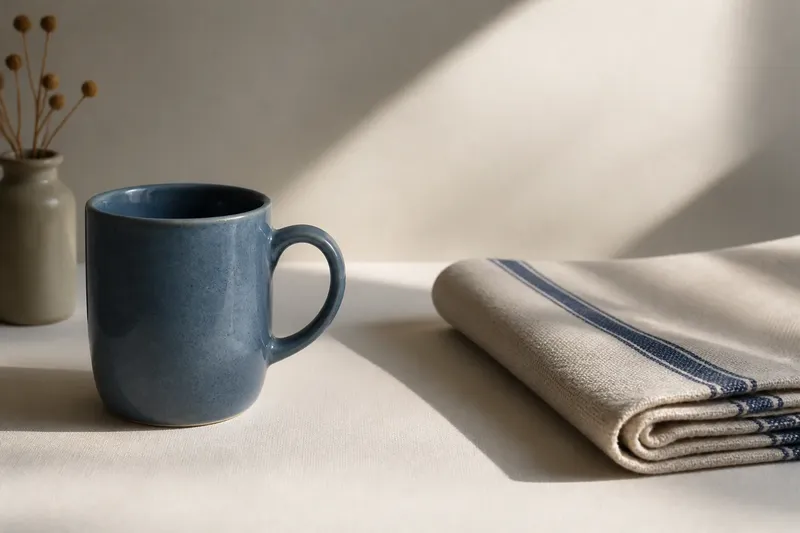
Say you place a blue mug on a white sheet with its handle facing a folded tea towel. In the first phone image, the gap between handle and towel narrows into a sharp wedge. You turn the mug so the handle faces away, then take another image from the same spot. The wedge becomes a broad opening and the scene feels calmer, though the mug and towel now seem less connected. The result is a clear trade-off: the first arrangement has more tension, while the second gives the objects more visual separation.
What changes when you photograph the arrangement?
A camera frame can reshape negative space. The viewfinder or phone screen excludes part of the room, so a gap that looks generous in person may become a thin strip at the edge of the image. A slight change in viewpoint can also make objects overlap, closing one opening and creating another.
Keep the camera in one place while comparing arrangements. This makes it easier to tell whether a change came from moving an object or changing the viewpoint. If the scene still feels different from what you saw directly, inspect the photograph’s edges: the crop may have altered the shape you were responding to.
When drawing, try shading the open areas lightly before filling in the objects. When photographing, you can trace a shape with your eye along the phone screen’s border. Both methods help make the background contours visible.
Which questions help you read negative space?
Does negative space have to be plain?
No. A patterned cloth or textured wall can still form negative space, though its details may compete with the larger shape. If the contour is hard to see, simplify the background or change the viewing angle.
Can a small gap matter more than a large one?
Yes. A narrow opening may have a striking contour, while a broad area may be visually quiet. Notice the gap’s shape and direction, not only how much surface it covers.
Should negative-space shapes match?
No. Similar shapes can create a calm rhythm, while contrasting shapes can make a still life feel more varied. Choose the relationship that supports the scene’s mood rather than trying to make every opening alike.
What if the open area becomes the main subject?
That can work if its shape is compelling and belongs to the arrangement. If it pulls attention away unintentionally, shift an object, simplify the background or adjust the crop.
How can you use negative space in your next still life?
Before adding another object, look at the contours already present. A spoon, cup and napkin may create more interesting shapes through their gaps than they would as separate subjects. Moving one item can change those shapes without making the arrangement busier.
For a quick check, take a phone photograph and trace the largest open shape with your eyes. Then inspect the smallest gap that feels unusually sharp or crowded. Reading both the broad area and the small interruption gives you a more precise way to decide what mood the still life is making.