Before the Snapshot: The Family Album as a Chosen Story
A family album is a chosen story, not a complete record. Learn how selection, sequence and revisiting can make its account of shared life clearer.
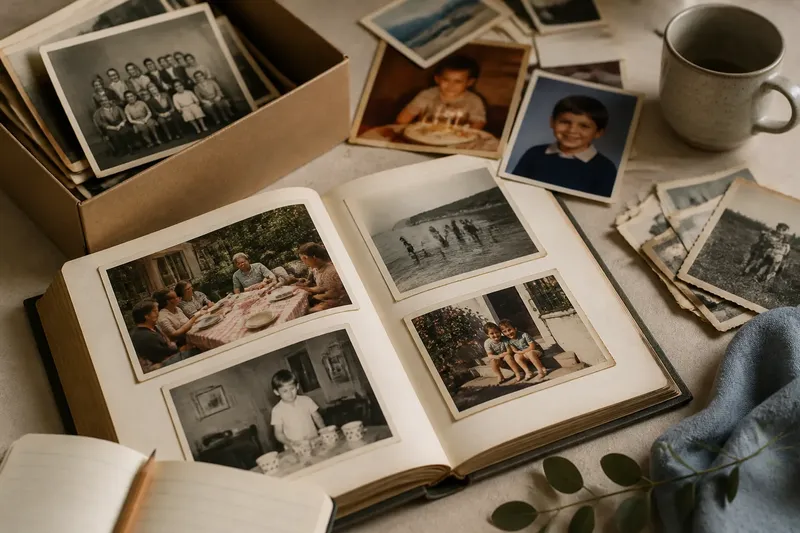
A family album can begin with a shoebox on the kitchen table: holiday prints beside school portraits, a blurred birthday and a photograph of someone who is no longer there. Making those pictures into an album is not simply a matter of preserving them. A family album is a chosen story, shaped by what stays, what comes first and what a later viewer notices.
That choice need not be a verdict on the family or the events. It is a way to make a useful, honest account from a partial set of pictures. The right approach depends on what you want the album to do: help someone remember a particular occasion, show how relationships changed, make room for several viewpoints or keep a loose collection open to later additions.
What kind of family story should the album tell?
Before sorting, name the album’s purpose in a plain sentence. “A record of our seaside holidays” gives a different selection rule from “A portrait of the people who gathered at home”. The purpose does not need to appear as a formal title. It simply helps you decide whether a photograph belongs.
If you want a story of one occasion, keep the pictures that carry its movement: preparations, arrivals, a shared moment and the quieter scene afterwards. If you want a broader account of shared life, look for recurring people, places and routines across different occasions. In either case, a pile containing every available image may obscure the thread you hoped to preserve.
Imagine you are making an album of a family’s recurring Sunday lunches. You find a posed group portrait, several photographs of the same table and one image of a child setting out mismatched cups. If the album is about the ritual as lived, the child’s small task may reveal more than another near-identical group pose. Keeping one table photograph can leave space for the detail that gives the gathering its texture.
Which selection suits the material you have?
Start by separating photographs into broad groups rather than judging every print at once. A table, clean envelopes and removable notes are enough for a first pass. If you are working with digital files, make copies before sorting and use folders or temporary albums so the original collection remains unchanged.
- For a single event: Keep a few images that mark changes in the day, not every frame of the same moment. This suits a wedding, reunion or birthday when the album should be easy to follow.
- For a family across time: Sort by recurring people, homes, journeys or habits. This suits a collection that spans different occasions and is meant to show continuity as well as change.
- For an uneven archive: Let the surviving material set the scale. A few photographs from one period and many from another can still make a meaningful album if the gaps are not disguised.
- For a collection with uncertain identities: Keep the photograph, but mark names or dates as uncertain rather than filling the gap with a guess. This suits albums that may be shared with relatives who can add context later.
- For several people’s memories: Invite others to nominate images and explain why they matter. This suits a shared album where one person’s idea of the important moment may not be everyone’s.
Selection is also a decision about absence. A picture may be technically clear yet tell little; a faded one may hold a place, a gesture or a relationship that no other image preserves. Consider what information each photograph contributes to this particular album, not whether it seems impressive on its own.
How should the photographs be ordered?
Chronology is useful when the sequence of events matters. It helps a reader understand who arrived, what happened and how the occasion ended. But strict date order can make a longer family album feel like a calendar. A looser sequence can bring together pictures that speak to one another across years: the same kitchen, changing faces at a doorway or a familiar pose repeated in a new setting.
Choose an order that supports the album’s purpose. For a single event, a beginning-to-end sequence is often clearest. For a long-running family collection, small groups organised by place, relationship or repeated activity may be easier to read than one uninterrupted timeline. A photograph can also work as a pause between groups, especially if it shifts the reader from one household or period to another.
Lay prints out before attaching them, or make a temporary digital sequence. Read through it as someone who did not attend the events might: can they tell when a new group begins, and do repeated images add something rather than stall the story? Captions can supply context that a photograph cannot carry alone, such as a name, an uncertain date or why an ordinary-looking room matters.
How can you include more than one point of view?
Family photographs often reflect who held the camera and who was considered worth photographing. A collection may show a celebration from one person’s position while leaving their work, absence or discomfort outside the frame. An album cannot restore what was never photographed, but it can avoid presenting its selection as the whole account.
Ask relatives what they would keep, and listen for differences rather than forcing agreement. Someone may choose a quiet portrait because it recalls a conversation; another may prefer the crowded group photograph. You can include both when each contributes a distinct memory. A short caption can identify whose recollection it is, so a personal interpretation is not mistaken for a settled family fact.
When a photograph involves sensitive circumstances, think about the people pictured and the audience for the album. You might keep a private print out of a widely shared version, or add it only after discussing it with those most affected. If the album will circulate among relatives, agree where it can be viewed and who can copy or share its contents.
What questions help when family albums feel difficult to sort?
Should every person appear equally often?
Equal representation may be a useful aim if the album is meant to gather several people’s stories, but matching image counts is not the same as fairness. Consider whether someone is missing because the photographs were never made, were lost or have not yet been identified.
What if the date or identity is unclear?
Use a cautious caption such as “possibly taken at the old flat” or leave a discreet question for relatives to answer. Keeping uncertainty visible is more useful than turning a guess into family record.
Can an ordinary photograph belong?
Yes, if it shows a detail that carries meaning for the album: a familiar room, a habitual task or a person’s place in a gathering. Its value depends on the story being told, not on whether the moment looks remarkable.
Should an album include difficult memories?
That depends on its purpose and on the people who may see it. A shared account can acknowledge loss or separation without displaying every private image; discuss sensitive material with those involved before including it.
How does revisiting change the story?
An album’s meaning can shift as viewers recognise faces, learn names or remember an event differently. Leave room for that change. A removable caption slip, a note in the back cover or a digital description can hold added information without pretending that the first arrangement was final.
When you return to the album, notice which pictures now seem central and which feel less important. You might add a relative’s recollection, correct a tentative date or make a second version for a different audience. Keep the earlier selection if it matters to you; changing the account does not erase the experience that shaped it.
A family album is strongest when its limits are legible. State what it gathers, identify what you can, and let gaps remain gaps where the evidence runs out. Then the album can offer something more thoughtful than a claim to completeness: a particular, revisable account of shared life, made with care for the people who will look back through it.